


Directed by: Peter Hoar, Amanda Brotchie, Makalla McPherson, Ben A. Williams, Alex Sanjiv Pillai
Distributed by: Disney+
Written by Anna Harrison
40/100
When newly-christened (for the second time) showrunner Russell T. Davies announced that David Tennant and Catherine Tate would return to “Doctor Who,” I was skeptical, but I could rationalize it: after years of sagging ratings and critical reception, “Doctor Who” needed an easy way to entice viewers to return, and bringing back the golden children of “Who” would—hypothetically—do just that. It was a lazy choice, yes, but one that I could convince myself was necessary. I could tell myself that next season RTD would let his new Fifteen Doctor (Ncuti Gatwa) shine without the baggage of the past. Next season we would see a showrunner more confident in his Disney-mandated eight-episode runtime as opposed to the usual thirteen under BBC rule. Next season, next season, next season.
Well, next season has come and gone. For five—maybe six, if we push it—episodes, my wish came true. “Doctor Who” was back.
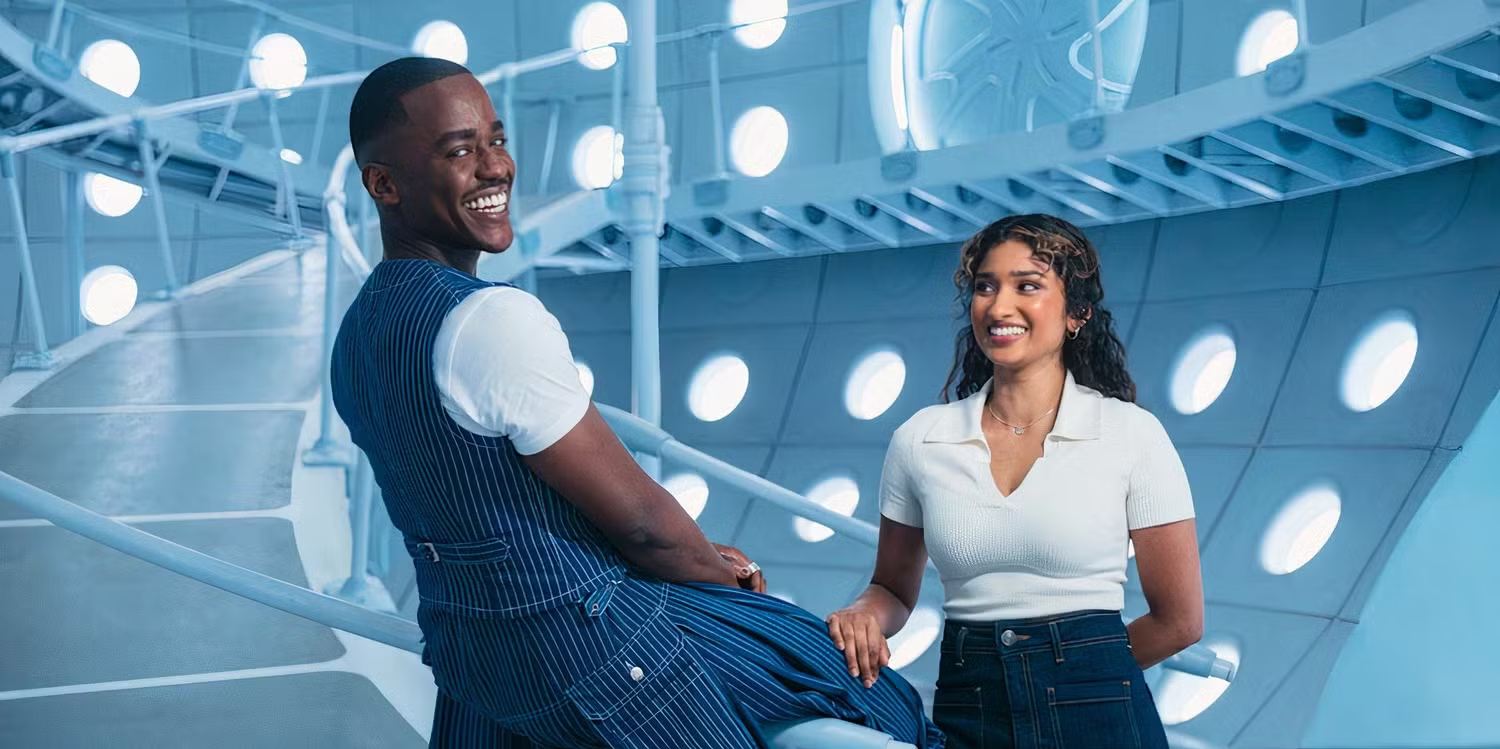
Those first five episodes were the steadiest the show has been since season ten, when the Twelfth Doctor (Peter Capaldi) and Bill (Pearl Mackie) traveled the galaxy. Our new companion, Belinda (Varada Sethu), immediately proved more interesting than the companion of last season, Ruby (Millie Gibson), who was let down by poor writing. After rescuing Belinda from a robot abduction, the Doctor tries to get her home, only to find that May 24, 2025 is inaccessible, even with the time-traveling TARDIS. Belinda, suddenly thrust into a situation she did not want, finds herself at odds with the Doctor, and in pushing back against him, she made the Doctor more interesting. The companion should not just be a yes man, but should challenge the Doctor and keep his ego in check; Belinda did just that, and thus Gatwa was able to employ his dazzling charisma to the fullest as he draws her into his orbit and clashes with her.
There are even some all-timer episodes in this season in “The Well” and “Lux”—the former proves a worthy sequel to the iconic season four episode “Midnight” (though whether it needed to be a sequel is another question), and the latter features one of the more terrifying villains in a cartoon voiced by Alan Cumming while managing to tug at the heartstrings by getting meta about the “Who” fandom. The episodes are clever, feature memorable side characters, and showcase the best aspects of the Doctor-companion dynamic, making me optimistic about the future of “Who.”
But the cracks still showed. The rushed conclusion of “The Story & the Engine” proved that the show has still not figured out how to balance eight shorter episodes in a season, but the sheer creativity and ambition present throughout the episode made the issues seem like, well, nonissues. I was willing to let it slide. Even “The Interstellar Song Contest,” where Belinda is horrified at the Doctor’s torture of a genocide victim only to hug him and talk about how great he is moments later, had such a jaw-dropping visual at the top of the episode that I almost forgot I was watching “Doctor Who.” If the penultimate episode, “Wish World,” was messy, that was just how Russell T. Davies’ two-parter finales have been for the past twenty years.
Then along came “The Reality War” (spoilers ahead).
It has become apparent in the days since airing that at least some of its faults were unavoidable. Disney was slow to renew the show, and Gatwa, unwilling to sit on ice without pay for a year, decided to exit the show after filming. This necessitated reshoots, but the episode’s flaws were glaring even before that abysmal, reshot ending.
To give a quick rundown: Mrs. Flood (Anita Dobson), who had appeared all throughout both last season and this, turns out to be classic “Who” villain the Rani (fun). She bi-generates (just as idiotic as it was last season) into two Ranis: Dobson and Archie Panjabi (Panjabi is great). The Rani has some very nonsensical plan to end the world that is so confusing I stopped trying to understand it (bad). This plan involves the return of another classic “Who” villain, Omega (cool). Omega, it turns out, is just a big blob of a CGI monster, and eats Panjabi’s the Rani before she can do much of anything (not cool). He’s vanquished too easily and with an overblown Murray Gold score blaring in the background, just like fellow classic “Who” CGI blob Sutekh from last season (very not cool). The Doctor vanquishes Omega with what amounts to a gun, despite the design of his sonic screwdriver changing so kids wouldn’t pretend to shoot at each other, and despite one of the Doctor’s big rules being that he never uses guns so the times when he does pick up a gun—“The End of Time,” “A Town Called Mercy,” “Hell Bent”—hit harder, and he never acknowledges this (deeply stupid).
Russell T. Davies has, historically, penned rushed and overstuffed “Doctor Who” finales. But even at their most bombastic, they—usually—managed to land the emotional beats. As the last of the Time Lords, the reveal of both the Rani and Omega’s survival should have merited more than just a few lines from the Doctor. Think back to when the Doctor encounters Derek Jacobi or John Simm’s Master in seasons three and four and how much weight that carried. While neither the Rani nor Omega have quite the storied relationship with the Doctor that the Master had, with the show’s renewed emphasis on the Doctor being the last of his kind, it stings that Davies dropped the ball so badly. Part of this is no doubt due to the shorter episode runtime, but Davies’ foolish attempt to reveal those two and then tie everything (well, most things) up in a few episodes bears the brunt of the blame, robbing the episodes of what could have been a well of emotional depth.
These were all issues before the reshoots. So what happened after?
To give another quick rundown: in the Wish World of the previous episode, the Doctor and Belinda had a child, Poppy (Sienna-Robyn Mavanga-Phipps, innocent), who was seen in last season’s terrible “Space Babies” (confusing why she is relevant to Belinda, who was not in the show at this point, but okay). When the Doctor returns the world back to normal, Poppy is no longer there, and no one remembers her but Ruby (sure, I guess). When the Doctor finally remembers, he does some wibbly-wobbly, timey-wimey stuff to bring back Poppy (whatever floats your boat). In doing so, he crosses paths with the Thirteenth Doctor (Jodie Whittaker), who brings a wonderful energy to the screen and almost made me miss Chibnall’s era before I remembered “Kerblam!” exists (great, very happy for Whittaker). The Doctor manages to bring back Poppy by using some of his regeneration energy, only now Belinda’s entire life story has been rewritten to be a single mother despite never mentioning a desire for children and despite spending most of the episode inside of a literal box (really, really terrible). The Doctor then regenerates into Billie Piper (WHAT THE FUCK).
No matter how tight a corner Disney backed Davies into, there is no excuse for the dearth of creativity on display here. Just the treatment of Belinda alone should warrant a harsh condemnation. The woman who started this season explaining to her incel-coded ex-boyfriend that she had no desire to become a housewife ended her run of episodes being forced into single motherhood with no say in the matter, and the audience spends so little time with Poppy that the Doctor sacrificing his own life and changing Belinda’s elicits nothing but emptiness from the viewer. (At the very least, it has made me feel vindicated for defending ex-showrunner Steven Moffat from the camp who, over his tenure, claimed he was sexist.) But the worst choice, of course, is bringing back Piper.
Tennant’s return was bad enough, but to sandwich the radiant Gatwa—the first black Doctor unless we are counting Jo Martin’s brief appearances as the Fugitive Doctor—between not only Tennant but Davies’ other (white) favorite is laziness beyond belief. This is nothing against Piper (though I always found Rose Tyler to be the least interested “Who” companion until Chibnall’s era, but that’s another essay) and everything against Davies, whose faith in his own show is so low that he feels the need to bring back another fan favorite, preferring to jangle the keys in front of the audience from twenty years ago rather than write anything fresh that might entice new viewers. The show has become a shell of its former self, paralyzed and unable to remove its gaze from its own navel.
Davies is stuck in 2005. I think it’s high time someone told him that 2005 was two decades ago—move the fuck on, or the world will move on without Davies and without “Doctor Who.”
Episode ranking:
- “The Well”
- “Lux”
- “Lucky Day”
- “The Story & the Engine”
- “The Robot Revolution”
- “The Interstellar Song Contest”
- “Wish World”
- “The Reality War”
“Doctor Who” Season Fifteen Trailer

You can follow more of Anna’s work on Letterboxd, Twitter, or Instagram, or her website.
